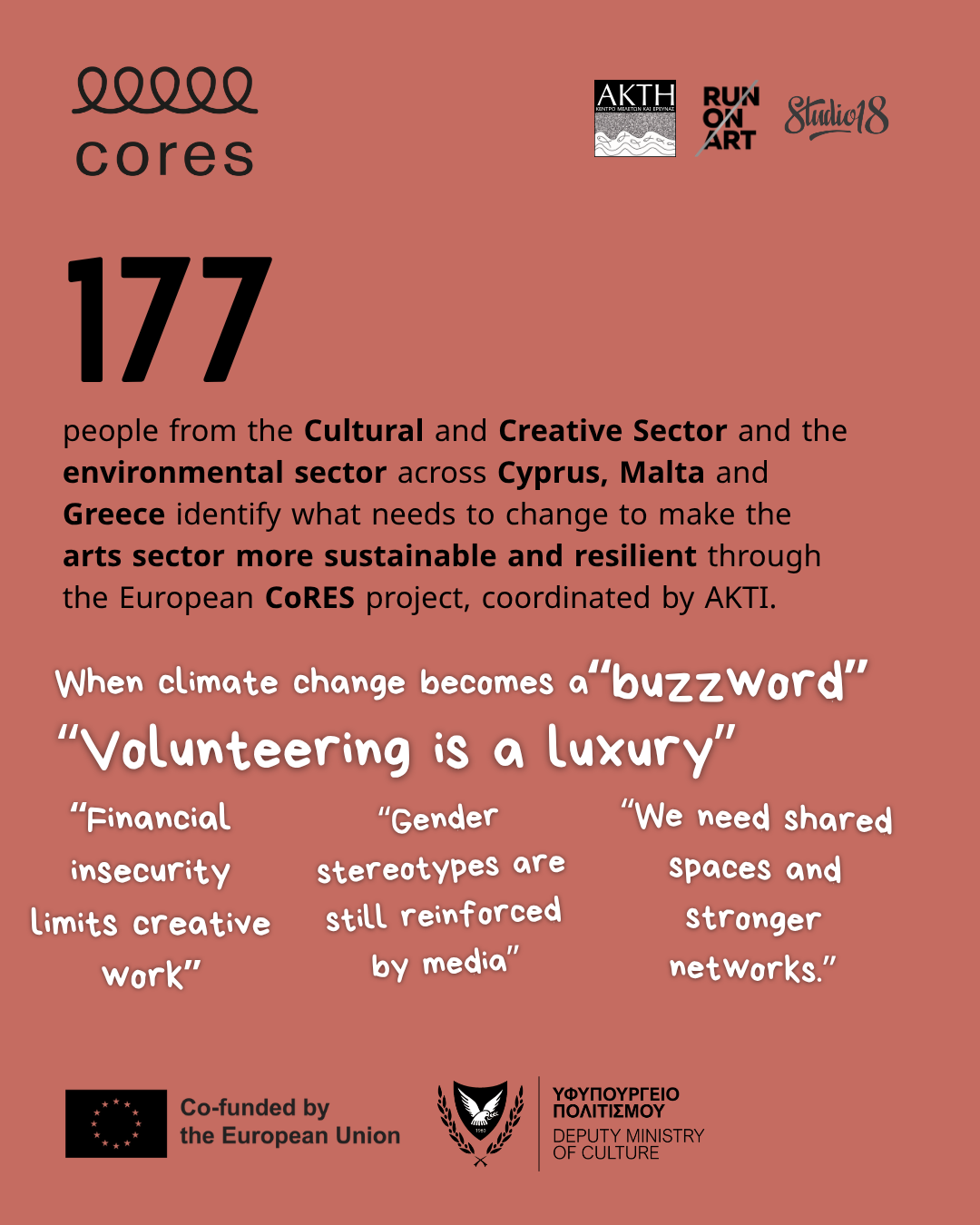
From climate fatigue and bureaucracy to artists’ financial insecurity and gender inequalities, 177 people from the Cultural and Creative Sector and the environmental sector in Cyprus, Malta and Greece are identifying what needs to change to make the arts sector more sustainable and resilient through the European CoRES project, coordinated by AKTI.
The European project CoRES – Creativity, Resilience, Environment, Sustainability: A Cultural Paradigm for a more resilient Art world is implemented by AKTI (Cyprus), RUNONART (Greece) and Studio 18 (Malta). Through innovative, applied participatory research methods, the project explores the gaps, needs and barriers to the green transition of the cultural and creative sector and works with people in the sector to co-design solutions for a more sustainable and resilient future.
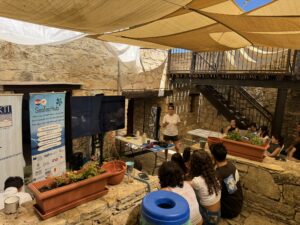
The 177 participants included representatives from the Cultural and Creative Sector and the environmental sector, as well as young creative practitioners aged 18–30. They took part in participatory activities held in Amargeti, Paphos (Cyprus), Valletta (Malta) and Athens (Greece). Discussions focused on the sustainability and green transition of the cultural and creative sector, climate mainstreaming and gender mainstreaming within the sector.
Sustainability and the green transition of the cultural and creative sector
One of the clearest findings from the workshops is that people in the sector are willing to adopt more sustainable practices, but often lack the conditions needed to put them into practice. Across the workshops, practical barriers included limited funding, bureaucracy, inadequate infrastructure, limited access to sustainable materials and resources, a lack of available public spaces and a shortage of environmentally friendly alternatives.
Different barriers also stood out in each country. In Cyprus, participants highlighted mindset and the lack of a “critical mass”. In Malta, they identified inadequate infrastructure and the need for instant gratification. Malta also brought the financial insecurity of artists into focus: many need to take on unrelated jobs to make a living, leaving them with less time and fewer resources for their creative work. The phrase “Volunteering is a luxury” highlighted how unpaid opportunities can exclude those without financial security. In Greece, positionality and mindset were identified as key barriers to advancing the green transition of the cultural and creative sector.
Proposed solutions included experiential learning, knowledge exchange, community engagement, creative expression, stronger collaboration and a more supportive institutional framework.
The findings show that participants do not see the green transition as a purely environmental issue that can be reduced to isolated sustainable actions. Instead, they see it as a broader transformation requiring adequate resources, collaboration, education and more enabling institutional conditions.
Climate mainstreaming in the cultural and creative sector
When asked what comes to mind when they hear the term “climate change”, participants mentioned panic, fear, sadness and guilt, but also responsibility, hope and the need to take action. Young creative practitioners described climate change as both a challenge and a call to action, while also associating it with fatigue and helplessness.
Another interesting finding was the fatigue surrounding the term itself. The word “buzzword” appeared in participants’ responses, reflecting concern that repeated use of the term “climate change” can weaken its meaning when it is not accompanied by meaningful action.
Young participants stressed that climate-related challenges require a multidisciplinary approach to decision-making, involving people from different sectors and professional backgrounds. They also called for stronger monitoring and evaluation of climate initiatives, including regular monitoring, evidence-based assessment and continuous feedback, to determine whether the measures being implemented are achieving their intended goals and results.
Gender mainstreaming in the cultural and creative sector
Discussions on gender mainstreaming identified gaps and needs across seven areas: education; gender stereotypes in the media; recognition of women’s historical contributions; women’s representation in decision-making positions; meaningful participation in democratic processes; recognition of women’s achievements; and financial support for the creative sector.
In Cyprus and Malta, participants prioritised education and the role of the media as the most important gaps and needs. In Greece, two additional issues were identified: regression and growing challenges related to human rights and gender equality, and inequality in the distribution and management of roles and responsibilities. Greek participants then identified these two issues as the most important, setting their priorities apart from those identified in Cyprus and Malta. In Greece, proposed responses included more conscious choices in both material and media consumption, stronger solidarity in the workplace and a more equal distribution of parental and family responsibilities.
More broadly, participants called for greater recognition of women’s achievements, more visible and credible female role models, less gender bias and stereotyping in the media, and better access to funding. Summary results-CAs
The findings from the six activities will feed into the development of the DeCyDe-4-Arts Policy Tool, a solution-oriented policy tool aimed at strengthening climate resilience, social inclusion and representation in the cultural and creative sector. The tool will be disseminated to more than 20 relevant stakeholders following the completion of the project. Summary results-CAs
CoRES – Creativity, Resilience, Environment, Sustainability: A Cultural Paradigm for a more resilient Art world is co-funded by the European Education and Culture Executive Agency (EACEA) under the Culture strand of Creative Europe 2021–2027, and by the Deputy Ministry of Culture of Cyprus.