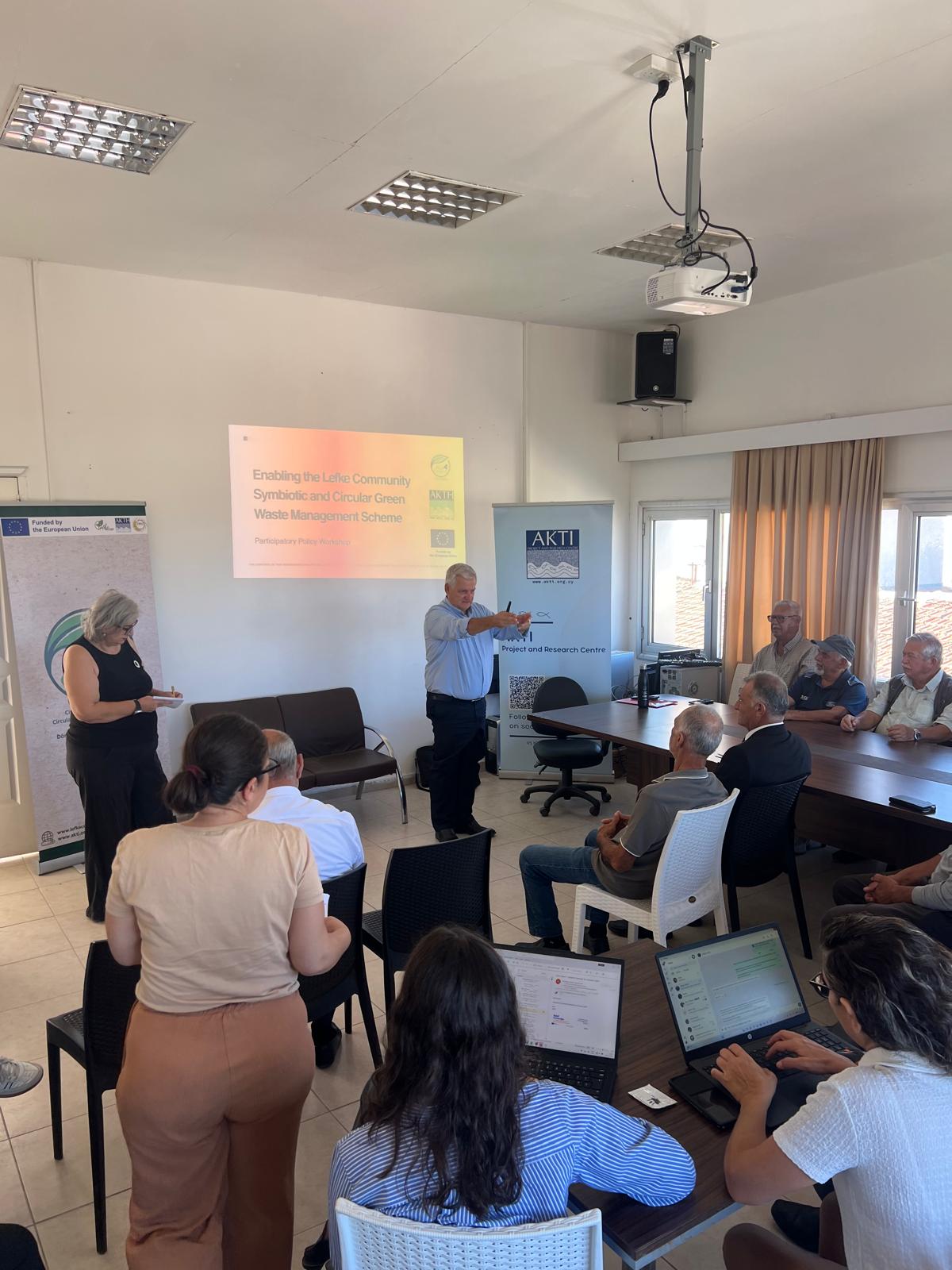
A more sustainable approach to managing agricultural waste in Lefka/Lefke was at the centre of a participatory Policy Workshop held at the Lefka/Lefke Town Hall on 9 October 2026. The workshop brought together local stakeholders to identify challenges and shape practical policy solutions for turning organic waste into valuable compost through a locally adapted circular waste management system.
The workshop took place within the framework of ALL4COMPOST, which is funded by the European Union under the Aid Programme for the Turkish Cypriot community and implemented by the Chamber of Agricultural Engineers, AKTI Project and Research Centre and the Lefke Environment and Ecology Association. ALL4COMPOST aims to promote circular green waste management by transforming organic materials, including pruning waste, animal manure and dried plant residues, into valuable compost that supports healthier soils and creates economic opportunities for local agriculture.
The workshop brought together 34 participants, including project partners, local producers, farmers, civil society representatives and interested citizens. Aziz Kaya, head of the Lefka/Lefke local community, also expressed support for the initiative. Representatives from the Lefke Environment and Ecology Association emphasised the importance of using natural resources more efficiently, reducing organic waste and encouraging the wider adoption of environmentally friendly composting practices.
Building on earlier mapping and co-design activities, the workshop focused on the proposed Lefke District Symbiotic and Circular Green Waste Management Scheme. Dr Michael Loizides, Member of AKTI’s Board of Directors, presented the project’s progress, previous activities and proposed management scheme, while Erkut Uluçam, President of the Chamber of Agricultural Engineers, provided further updates on project implementation.
Through presentations and open discussions, participants examined the challenges of putting the scheme into practice and explored policy measures tailored to the region’s needs and available resources. Discussions covered the entire composting process, from collecting agricultural residues and producing compost to distributing and using it on farmland. Particular attention was given to the costs, infrastructure and practical arrangements needed to make the system accessible to local producers and sustainable in the long term.
One of the key findings was the potential to make better use of existing local resources. Discussions highlighted that municipal machinery capable of processing large pruning residues is already available, but high fuel costs limit its use. Shared access to equipment, coordinated collection services and operational support emerged as possible solutions, particularly for older orchards where access and transportation are challenging. Other important issues included the open burning of agricultural residues and the presence of plastics in collected organic waste. Participants explored awareness campaigns, improved waste separation, collection support and incentives to encourage more sustainable practices. For compost distribution and agricultural use, discussions also considered shared machinery, cooperative transport and practical support to reduce the Scheme’s operational costs.
Across all stages, cooperation between local authorities, farmers, CSOs and other stakeholders, shared infrastructure and financial support emerged as key priorities
The workshop findings will contribute to the development of practical policy recommendations adapted to Lefka/Lefke’s local needs. ALL4COMPOST now moves into its demonstration and training phase, taking the next step towards putting circular green waste management into practice.