Through the European project HUBS4BUILD, AKTI will test the production of thermal insulation from seagrass and the reuse of excavated soil in Cyprus, while coordinating similar initiatives to turn waste into new products in Austria, Hungary, Serbia and Ukraine.
Thermal insulation from seagrass, building materials made from leftover bread and insulation panels produced from food waste. These are just some of the solutions being explored through HUBS4BUILD, a new European project involving AKTI Project and Research Centre. The aim is to reduce waste and the environmental impact of the construction sector by finding new uses for materials that would otherwise be discarded. In Cyprus, AKTI will focus on making use of Posidonia oceanica residues and excavated soil, with pilot trials planned in the Limassol district.
Funded by the EU’s Horizon Europe programme, HUBS4BUILD brings together universities, research centres, technology companies, local authorities and civil society organisations from 13 European countries. The project will establish 13 regional Circularity Hubs to test new ways of turning local waste into useful products. The solutions will be tested under real-world conditions to assess their technical performance, environmental impact and economic viability. The project will also explore how businesses and local authorities can put these solutions into practice, creating new opportunities for local economies.
In Cyprus, the pilot activities will take place in the Limassol district, coordinated by AKTI in collaboration with the Complex of East Limassol Community Services, the University of Rostock, German specialists in seagrass processing, and local organisations and professionals.
AKTI will coordinate the production of natural thermal insulation from Posidonia oceanica residues. This seagrass, found only in the Mediterranean, supports marine biodiversity and captures and stores carbon. Even after its dead leaves wash ashore, they continue to play an important role in coastal ecosystems. The deposits they form absorb some of the energy of incoming waves, trap sediments and help protect beaches from erosion. As they break down, they also provide organic matter and nutrients that support coastal food webs.
Local authorities often remove these deposits from beaches for tourism-related and aesthetic reasons. AKTI will use material that has already been collected and would otherwise be discarded, turning it into natural thermal insulation. Organic residues left over from processing will be used to produce compost. The project will also test ways of separating and reusing excavated soil in construction, including applications such as natural plasters and drainage layers. Further trials will explore ways to recover and reuse water.
AKTI will also coordinate similar waste recovery and reuse trials in four other European countries, working with local partners. In Austria, leftover bread will be used to produce furniture boards, while innovative materials will be developed for 3D-printed building components. In Hungary, agricultural straw will be turned into mattresses. In Serbia, food waste and hemp fibres will be used to produce insulation panels. In Ukraine, demolition waste will be turned into paving slabs, while agricultural and woody residues will be used to produce fuel briquettes to support reconstruction efforts.
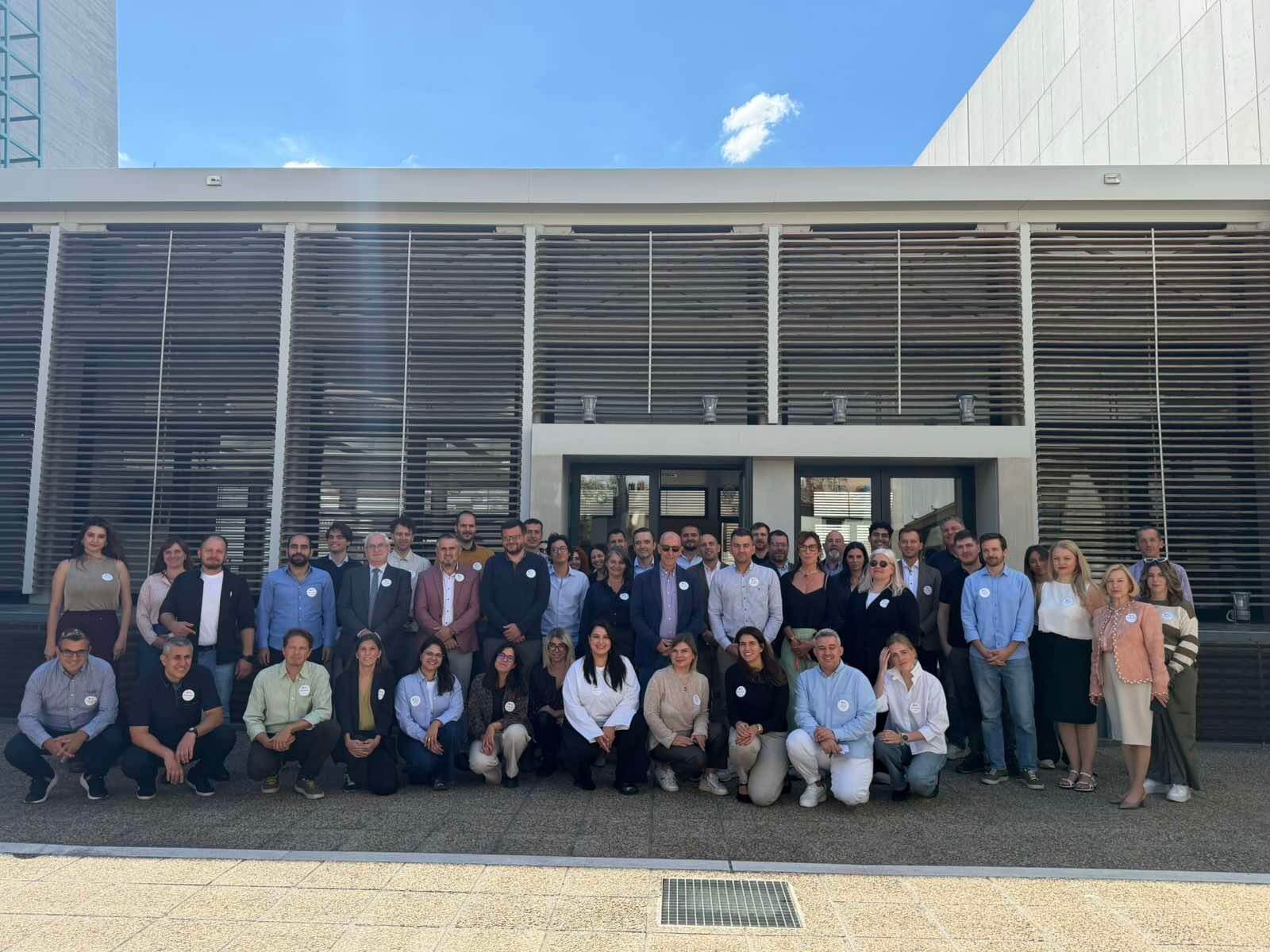
The HUBS4BUILD kick-off meeting took place in Kozani, Greece, from 28 to 30 September 2026, bringing together researchers, businesses and local authorities from across Europe. Project partners presented the solutions they plan to test in the 13 participating regions and agreed on the first steps towards implementation. In Cyprus, AKTI will begin by identifying available materials and working with local stakeholders to prepare the pilot trials in the Limassol district.
HUBS4BUILD will run for four years (2026–2030) and is coordinated by the University of Thessaly. Through its 13 regional applications across Europe, the project will explore how materials that are currently discarded can be put to new uses, reducing the need for virgin raw materials and creating new opportunities for the construction sector.
HUBS4BUILD – Regional Circularity Hubs for a Bio-based and Resilient Built Environment is funded by the European Union’s Horizon Europe programme (Grant Agreement No. 101291180).
Views and opinions expressed are, however, those of the author(s) only and do not necessarily reflect those of the European Union or the European Research Executive Agency (REA). Neither the European Union nor the granting authority can be held responsible for them.